Generative AI and AI-powered search are fundamentally changing user behavior in search and impacting the revenues of media companies. The zero-click effect is reducing click-through rates from search engines, while well-structured, product-oriented content has a higher chance of being used in AI-generated answers. As a result, product content and affiliate revenue can become an attractive part of the revenue mix for media companies. For publishers, this means that relying on traditional monetization models is no longer enough. It is necessary to combine high-quality content, performance-driven monetization, and new revenue streams. Alongside the most commonly discussed approaches, affiliate marketing may also represent a viable path to success. In addition to new revenue, it can secondarily support other important areas as well.
The Evolution of Search (AI) and Its Impact on Revenue
Traffic acquired through internet search engines is currently undergoing the most significant structural change since the rise of mobile search. Generative AI answers, AI Overviews, and other AI answer engines are transforming how users search for information, compare options, and decide whether to visit a specific website at all.
For media companies, this is not just a matter of SEO or visibility in search results—it is also a question of revenue stability. If the number of clicks from search declines, so does the volume of page views, on which a significant part of advertising monetization is still based for many publishers. The pressure on media business models today therefore comes not only from technological change, but also from a shift in how traffic is distributed.
It is fair to note, however, that this pressure did not start with the arrival of generative AI. Publisher business models were already under strain: declining traffic from social networks, falling CPMs, stricter anti-fraud controls, and an increasing share of budgets flowing into video, social platforms, and other partnerships. Generative AI did not initiate this trend, but it significantly accelerates and amplifies it.
The Zero-Click Effect in Numbers: What the Latest Data Shows
One of the most visible manifestations of this change is the so-called zero-click effect—situations where users get their answers directly in search engines or AI interfaces and therefore have no reason to click through to a publisher’s website.
An updated Ahrefs study shows that for queries with AI Overviews, the CTR of the first organic result dropped from 7.3% to 2.6%, a decrease of approximately 58%. This is not a blanket decline across all search clicks, but a very strong impact specifically where Google displays AI answers above traditional results.
The BBC reports even more dramatic declines for certain publishers. A Semrush analysis from the second half of 2025 shows that AI Overviews have expanded across query types, including commercial and transactional ones.
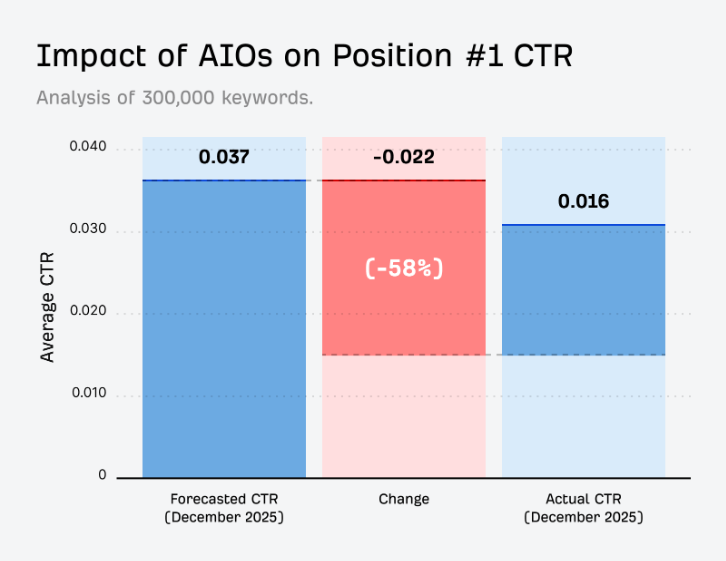
The Ahrefs chart shows how the CTR for the first organic result dropped after the rollout of AI Overviews | Source: Ahrefs, AI Overviews Reduce Clicks by 58%
From the perspective of organic search, this means for publishers:
- lower CTR from organic search,
- fewer visits coming from search engines,
- a lower volume of page views.
And if a significant part of monetization is based on the CPM model, a simple equation applies: fewer page views mean fewer impressions and therefore pressure on advertising revenues. At the end of 2025, Search Engine Land described how AI answers are affecting publisher revenues precisely because they weaken a model built on traffic and ad impressions (“How AI answers are disrupting publisher revenue and advertising”). In addition, Reuters reported in February 2026 on a complaint by European publishers against Google over AI Overviews. This shows that the issue is not just a marketing problem, but also one with regulatory and commercial implications.
AI Answers as the New “Front Door of the Internet”
Beyond declining CTR, something even more fundamental is changing: where users begin their journey toward information or decision-making. In its October 2025 analysis, McKinsey refers to AI-powered search as the new “front door of the internet.” It also estimates that by 2028, up to $750 billion in consumer spending in the US alone could flow through AI-based search. At the same time, 44% of users who have tried AI-powered search already describe it as their primary tool for obtaining information.

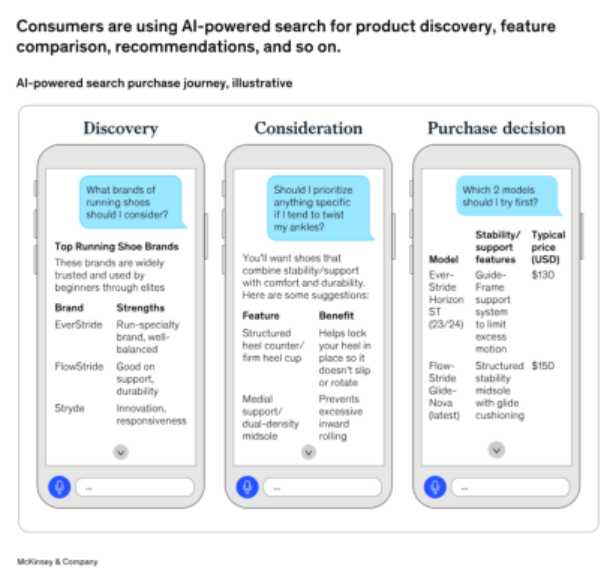
The decision-making process is shifting directly into the environment of generative answers, instead of starting with a visit to a website. | Source: McKinsey, Winning in the age of AI search
This is important for media companies because the way users discover information and make decisions is changing. The importance of content is growing—not just content that can be found via search, but content that also holds up as a trustworthy source for AI-generated answers.
What Content Does AI Search Actually Recommend?
Available analyses of AI answer citations suggest that product-oriented and highly structured content plays a particularly important role. An XFunnel study analyzed 768,000 citations across answers from ChatGPT, Google/Gemini, and Perplexity. The result shows that product content accounted for approximately 46% to over 70% of cited sources, depending on query type.
Such formats include:
- Product comparisons – articles that clearly compare two or more products or services based on defined parameters help users make decisions and provide structured data that LLMs can easily use.
- “Best of” articles – content like “Best XYZ” summarizes several options based on defined criteria and targets users who are actively seeking recommendations, increasing purchase intent.
- Detailed specifications and parameters – tables and precise information about products, prices, and features create trustworthy content that AI can read well and that supports user conversion.
- Alternatives to well-known brands, products, or services – content targeting users who already have a specific solution in mind but are actively considering alternatives.
- Structured FAQs – clearly defined questions and concise answers reduce user uncertainty and can be easily integrated into generative AI responses.
“At Philips, we see that in the era of AI-powered search, it will not be enough to have high-quality content only on our own channels. What will also matter is how products are presented on e-shops, comparison sites, websites specializing in product descriptions, and in high-quality reviews—because these sources already significantly influence how AI tools recommend brands and products,” said Martin Žižka, Senior Digital Marketing & E-commerce Manager at Philips.
It is important to emphasize one thing: AI tools do not prefer “affiliate links” as such. They prefer content that is valuable, structured, factual, and useful for decision-making. The fact that such content is often monetizable via affiliate models is a consequence of its practical value—not the reason it appears in AI-generated answers.
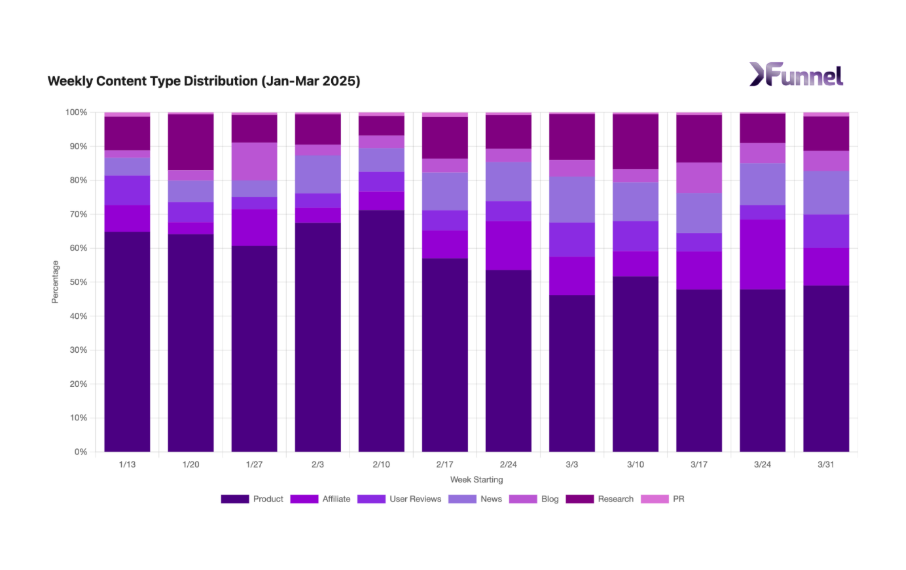
What content do LLMs recommend most often | Source: What should content strategy be for LLM Optimization? A study of 768k citations
Affiliate as One of the Tools for Revenue Diversification
If the economics of the page-view model are changing, it is not enough to focus solely on improving ad efficiency. Publishers need a broader and more resilient revenue mix. Alongside display advertising and direct sales, they can gradually develop additional pillars such as affiliate marketing, premium content, memberships, events, proprietary products and services, or new content licensing models (so-called pay-per-demonstrated-value models). In this context, Search Engine Land speaks of the breakdown of the old “blogging for dollars” model, which relied on a simple logic: drive traffic, show ads, earn revenue. This model is now under far greater pressure than before.
The Growing Share of Affiliate Revenue
Practical examples show that affiliate is not just a supplementary revenue stream for many media companies in Western markets. BuzzFeed reported $40.28 million in commerce and other revenue in Q1–Q3 2025 out of total revenues of $128 million, with affiliate accounting for the majority of this category. Dotdash Meredith reported 26% growth in affiliate commerce revenue during the same period, despite pressure from AI Overviews and declining Google search traffic. Digiday also noted that at Complex, 60% of revenue now comes from events and commerce, while the remaining 40% comes from advertising.
In Europe, a strong example is Future, which reported £76.7 million in eCommerce revenue in FY2025, while the Guardian is actively expanding its affiliate commerce project The Filter and views commerce content as part of broader revenue diversification alongside advertising and subscriptions. Unfortunately, detailed figures from local or at least CEE markets are lacking.
Affiliate revenue is not dependent on impression volume, but on performance. This means that even with lower traffic, revenues can grow if the publisher reaches an audience with a higher likelihood of conversion. It works best for content that supports specific decisions or purchasing intent. Combined with a trusted brand, affiliate can therefore be an important part of broader revenue diversification—even if it does not solve all problems on its own.
Competitive Advantages of Media Companies in AI Search
Compared to pure affiliate sites, media companies have one key advantage: trust, built over years through editorial work, specialization, and relationships with audiences. At a time when AI tools increasingly summarize and recommend information instead of directly driving traffic, this trust gains new value.
This is why media companies can have an advantage over purely performance-driven affiliate projects in selected verticals. If they can combine editorial expertise with regularly updated product content, they may become more trustworthy sources for users and AI tools alike than sites built primarily on SEO acquisition.
However, not every publisher will succeed automatically. The decisive factor will be whether product content is built systematically—with a clear methodology, regular updates, and alignment with business objectives.
How Do Affiliate Networks Fit into This Strategy?
The role of an affiliate network is not limited to technical tracking or basic advertiser integration. For publishers, equally important benefits include faster access to a broad partner portfolio, better insight into which verticals and offers perform well, and the ability to continuously optimize revenue based on real performance.
This is especially important at an early stage, when publishers are still identifying which categories offer the greatest potential for their product content. An affiliate network can help them test what works more quickly, scale successful formats, and turn product content into a more measurable revenue channel.
An affiliate network alone will not solve content or product strategy challenges. However, it can significantly reduce the cost of entering commerce monetization and serve as a practical tool for building a more resilient business model.
Conclusion
Data from the second half of 2025 and early 2026 confirm several trends that media companies should not ignore:
- the zero-click effect continues to reduce search click-throughs,
- AI tools are changing how users search for information and make decisions,
- advertising models purely based on page views are more sensitive to traffic volatility than before,
- product-oriented and well-structured content is becoming a more important source for AI tools,
- according to an Oxford study collecting data from publishers worldwide, 29% plan to increase affiliate revenue.
The question, therefore, is how quickly publishers adapt their content and monetization strategies to this change. This does not mean that product content or affiliate marketing are universal solutions. However, in an era where the traditional page-view model is losing some of its certainty, they can help media companies build a more stable and diversified revenue structure. The question today is no longer whether search is changing.Affiliate also does not mean only reviews and comparisons. For media companies, it can also serve as a foundation for additional monetization formats, such as loyalty programs. These can help publishers not only with monetization, but also with first-party data collection and with strengthening user motivation to return regularly to their ecosystem. More on this topic in one of the next articles.